Voice interaction
Push-to-talk, voice activity detection, recognition, and spoken AI responses require careful handling of input, focus, and turn-taking.

WORKING PROTOTYPE / AI + SIMULATION
A voice-first AI companion that brings conversational assistance into a live Microsoft Flight Simulator session.
Sim Companion explores spoken assistance during simulated flight, with aircraft observations providing context for the conversation. It is a working development prototype; live Windows, simulator, and headset acceptance testing remains incomplete.
Push-to-talk controls are part of the interaction design. Voice-only testing lets me evaluate conversations separately from simulator integration. It does not control the aircraft or transmit to air traffic control.
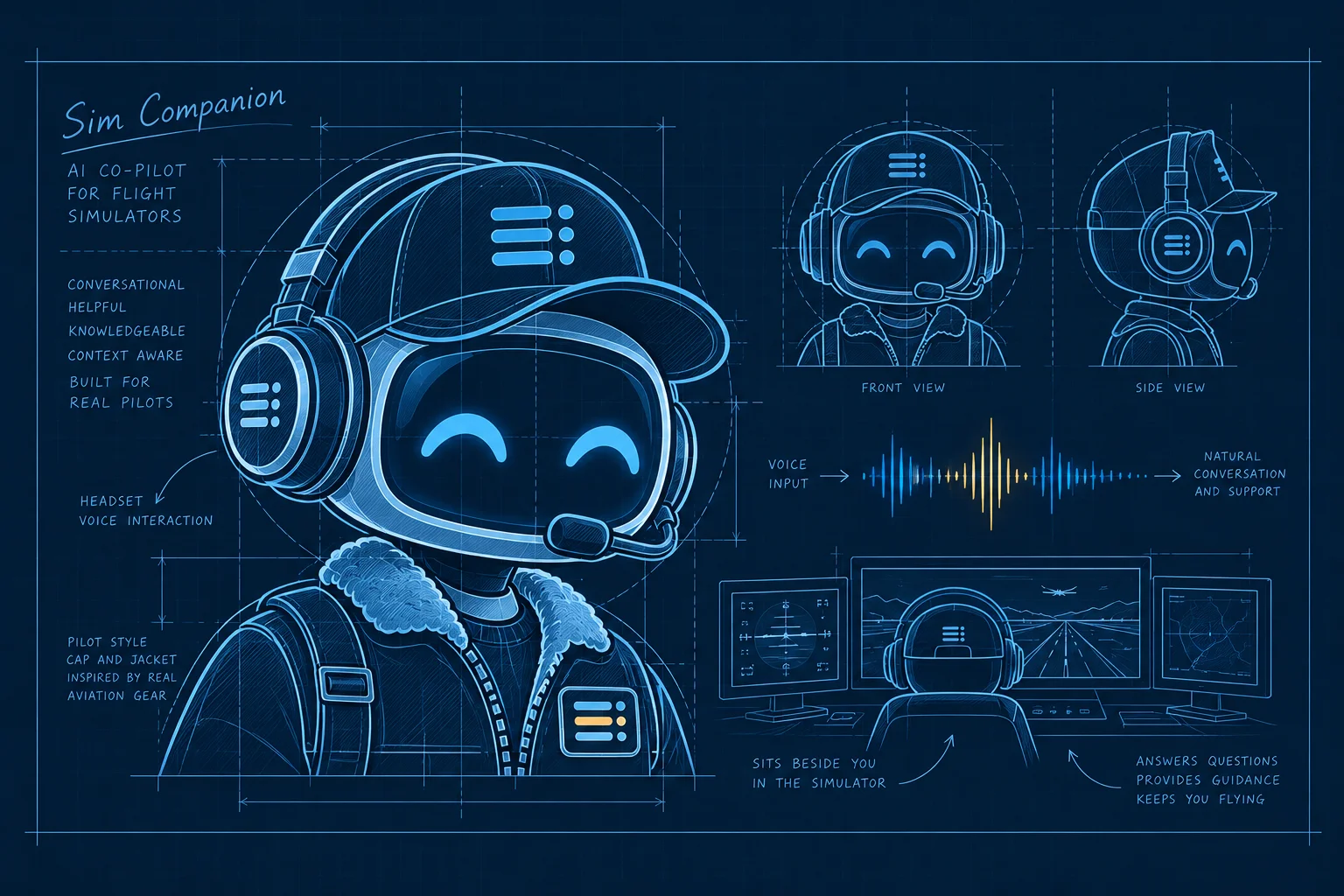
Push-to-talk, voice activity detection, recognition, and spoken AI responses require careful handling of input, focus, and turn-taking.
Bringing simulator telemetry and physical controls into the conversation creates integration challenges that voice-only testing cannot fully resolve.
Testing, observations of response time, and usage measurements help evaluate reliability and operating cost.
The current work is about understanding responsiveness, conversational quality, and reliability. Development checks and demonstrations are useful evidence, but do not replace a complete simulator acceptance test.
Sim Companion is a distinct, practical experiment. The lessons it reveals about voice, integration, and deployment can inform future work on flight trAIner without claiming that the two projects have the same instructional goals.
Sim Companion is experimental simulation software, not certified flight instruction or a replacement for a qualified instructor.
← Back to featured work